ChatClothes Virtual Try-On
Auckland University of Technology · Nov 2024 – Apr 2025
Role: AI Engineer & Python Developer (Independent)
Cover
1 / 39Master's thesis — a multimodal virtual try-on system combining lightweight YOLO classification with LoRA fine-tuned diffusion models and LLM agent control. Built on limited resources: two 16GB Tencent Cloud free-tier GPU servers (one for diffusion, one for LLM) + Raspberry Pi 5. Published at IVCNZ 2025. 94.2% accuracy, FID 28.5, completed 6 months early.
28.5
FID Score
19%↑
Improvement
75%↓
Hand Artifacts
94.2%
Accuracy
<10s
Latency (RPi5)
87%
User Success
50 users
User Study
6mo early
Timeline
Problem
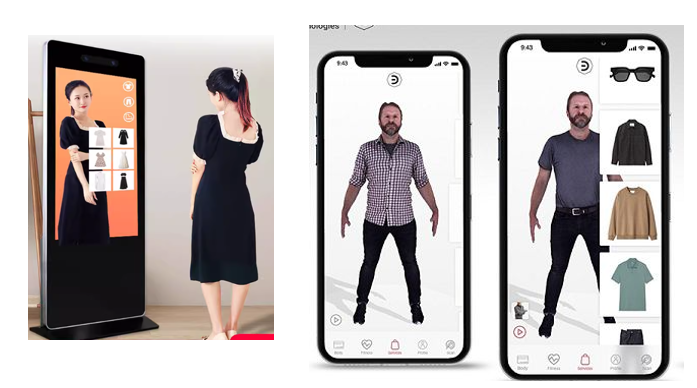
Fashion e-commerce lacks interactive, multimodal try-on experiences with natural language interaction.
Solution
Multimodal AI VTON: OOTDiffusion with LoRA fine-tuning for pose-aligned generation, YOLO12n-LC lightweight classifier (5MB, 8x smaller), DeepSeek LLM agent via Dify workflow for natural language to structured prompts.
Architecture
Python AI pipeline (PyTorch/ComfyUI/Dify) → FastAPI backend → PWA Android frontend
Key Highlights
- ▸Applied LoRA fine-tuning to OOTDiffusion for enhanced pose alignment and texture reconstruction
- ▸Built Dify workflow orchestrating LLM agent + diffusion pipeline + classification
- ▸Optimized YOLO12n to YOLO12n-LC for resource-constrained targets
- ▸Orchestrated DeepSeek LLM via Ollama for natural language control
- ▸Split system across two 16GB Tencent Cloud free-tier GPU servers (ComfyUI/OOTDiffusion on one, Ollama/DeepSeek on the other) — single-server fit was impossible
- ▸Thesis passed with First Class Honours, published at IVCNZ 2025
Tech Stack
What I Learned
Multimodal alignment needs iterative tuning; LoRA fine-tuning achieves significant quality gains without modifying the backbone; Dify workflow orchestration simplifies complex AI pipelines.